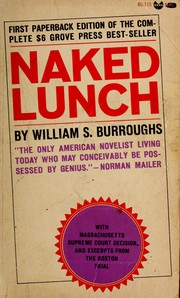
Naked Lunch
Burroughs's fragmented novel of addiction and control, first published in Paris.
Why it was banned: Found obscene by a Boston court in 1965; the Massachusetts Supreme Judicial Court reversed the ruling in 1966.
In printAffiliate link: Bookshop.org supports independent bookshops, and we earn a small commission at no extra cost to you.
What Naked Lunch is about
Naked Lunch has no conventional plot. It is a series of loosely connected sketches, or "routines", that follow William Lee, a drug addict on the run from the police, from New York to Mexico and into a nightmare city called Interzone, based on Tangier, and the police state of Annexia. The book mixes savage satire of the police, doctors, politicians and bureaucracy with grotesque scenes of sex, violence and drug use, and with the jargon of addicts. Burroughs presented addiction as the model for every kind of control: the drug pusher, he wrote, sells not the product to the consumer but the consumer to the product. Readers can begin at any chapter; Burroughs said the book could be cut in at any point.
The title was suggested by Jack Kerouac. Burroughs explained it as the frozen moment when everyone sees what is on the end of every fork.
The ban, in full
In 1958 the literary magazine Chicago Review printed excerpts, and the University of Chicago, under pressure from a newspaper columnist, stopped it from printing more. The editors resigned and founded a new magazine, Big Table, to publish the rest; the US Post Office refused to mail its first issue as obscene, though a court later ruled against the Post Office. The complete novel was published in Paris in 1959 by Maurice Girodias's Olympia Press, which had published Lolita. Grove Press published it in the United States in 1962.
In 1965 a Boston court found the book obscene. At the trial, Norman Mailer and Allen Ginsberg testified for the defence. In July 1966 the Massachusetts Supreme Judicial Court reversed the decision, applying the US Supreme Court's test that a work could not be banned unless it was "utterly without redeeming social value". It is often called the last major obscenity trial over a work of literature in the United States.
About William S. Burroughs
William S. Burroughs (1914–1997) came from a wealthy St Louis family; his grandfather founded the Burroughs adding machine company. A Harvard graduate, he became addicted to heroin in the 1940s and was a central figure of the Beat writers alongside Ginsberg and Kerouac. In 1951 in Mexico City he shot and killed his wife, Joan Vollmer, in what he described as a drunken game. He lived in Tangier while writing Naked Lunch, and later in London, New York and Lawrence, Kansas. His other books include Junkie and The Soft Machine.
Which edition to read
Naked Lunch: The Restored Text (2001), edited by James Grauerholz and Barry Miles, corrects errors in earlier editions and includes drafts and Burroughs's later introductions, including his testimony on addiction.
Reception and legacy
Naked Lunch influenced writers, musicians and filmmakers, from punk to cyberpunk. David Cronenberg's 1991 film combines parts of the book with events from Burroughs's life.
Questions
Why was Naked Lunch banned?
For obscenity: its graphic sexual and violent content and depictions of drug use.
Is it still banned?
No; the 1966 ruling cleared it. More: Howl and Other Poems, books banned in the United States.
At a glance
- Shelf status
- In print
- Banned by
- A court
- Banned in
- United States
- Why it was banned
- Found obscene by a Boston court in 1965; the Massachusetts Supreme Judicial Court reversed the ruling in 1966.
- Author
- William S. Burroughs
- Topics
- Drug Use, Heroin, Drug addicts, Recovering addicts, Autobiography, Beat Generation
- First published
- 1959
- Shelf note
- In print; ban history from the public record.
- Find a copy
- Bookshop.org ↗ (affiliate link)
Library record on Open Library
Banned Bookshelf lists books for reference. A listing is not an endorsement, and we host no copies.
Related
- All Quiet on the Western FrontClassics, Fiction
- Animal FarmClassics, Fiction, Politics & power
- Berlin AlexanderplatzClassics, Fiction
- Brave New WorldClassics, Fiction
- Burger's DaughterClassics, Fiction, Politics & power
- CandideClassics, Fiction
Cover image and topics: Open Library.