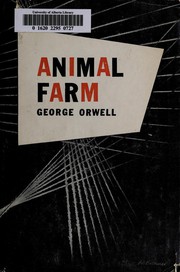
Animal Farm
A fable in which farm animals overthrow their farmer and are betrayed by the pigs who lead them, written as an allegory of the Russian Revolution and Stalinism.
Why it was banned: Turned down by several British publishers in 1944, while Britain was allied with the Soviet Union, and banned in the USSR and other Communist states.
In printAffiliate link: Bookshop.org supports independent bookshops, and we earn a small commission at no extra cost to you.
What Animal Farm is about
Inspired by the dying words of Old Major, a prize boar, the animals of Manor Farm drive out their drunken owner, Mr Jones, and rename their home Animal Farm. They paint Seven Commandments on the barn wall, the last of which is "All animals are equal". The pigs, being the cleverest, take charge. Two of them, Snowball and Napoleon, compete for leadership until Napoleon drives Snowball out with a pack of dogs he has secretly raised. With the help of Squealer, a persuasive pig who explains every new hardship away, Napoleon rewrites the commandments one by one, works the loyal carthorse Boxer to death and finally begins walking on two legs and trading with the neighbouring farmers. The single remaining commandment reads: "All animals are equal, but some animals are more equal than others."
Orwell subtitled it "A Fairy Story". Readers have always taken it as an allegory of the Russian Revolution and its betrayal: Old Major as Marx or Lenin, Napoleon as Stalin, Snowball as Trotsky, the dogs as the secret police.
The ban, in full
Orwell finished the book in February 1944, while Britain was allied with the Soviet Union against Nazi Germany, and found it almost impossible to publish. Victor Gollancz, his usual publisher, turned it down. Jonathan Cape accepted it and then withdrew after advice from an official at the Ministry of Information. Faber and Faber also declined; T. S. Eliot, then a director there, wrote Orwell a letter questioning the book's point of view. Secker & Warburg finally published it on 17 August 1945, after the war in Europe had ended.
Orwell wrote a preface, "The Freedom of the Press", about the reluctance of British publishers and intellectuals to criticise the Soviet Union. It was left out of the first edition and only found and published in 1972.
In the Soviet Union and the Communist states of Eastern Europe the book was banned; like Nineteen Eighty-Four, it circulated only in smuggled and underground copies until the late 1980s.
About George Orwell
George Orwell (Eric Arthur Blair, 1903–1950) was a democratic socialist who had seen Soviet-backed Communists suppress their left-wing rivals during the Spanish Civil War. He said Animal Farm was the first book in which he tried "to fuse political purpose and artistic purpose into one whole". Its success made him famous and financially secure for the first time, four years before Nineteen Eighty-Four.
Which edition to read
The novella is short (about 30,000 words) and the text is the same across standard editions. Look for one that includes "The Freedom of the Press" and Orwell's 1947 preface to the Ukrainian edition, in which he explains why he wrote it; many modern Penguin and Signet editions do. Like Orwell's other work, it is in the public domain in the UK and EU since 2021.
Reception and legacy
Animal Farm sold widely in Britain and the United States and became a school staple on both sides of the Atlantic. During the Cold War it was also used as propaganda: the 1954 British animated film was secretly funded by the CIA, and its ending was changed to show the animals rising against the pigs. In 2005 a Time magazine list named it one of the 100 best English-language novels published since 1923.
Questions
Why was Animal Farm banned?
In Britain it was never banned, but publishers refused it in 1944 because it attacked a wartime ally. In the Soviet bloc it was banned as anti-Soviet propaganda.
Is it still banned anywhere?
It is freely available in Russia and Eastern Europe. It has been restricted in some other states at various times. See more books banned in the Soviet Union.
At a glance
- Theme
- Classics, Fiction, Politics & power
- Shelf status
- In print
- Banned by
- A government
- Banned in
- Soviet Union
- Why it was banned
- Turned down by several British publishers in 1944, while Britain was allied with the Soviet Union, and banned in the USSR and other Communist states.
- Author
- George Orwell
- Topics
- Political satire, Classic, Animal drama, Fiction, political, Fiction, satire, Literature
- First published
- 1945
- Shelf note
- In print; ban history from the public record.
- Find a copy
- Bookshop.org ↗ (affiliate link)
Library record on Open Library
Banned Bookshelf lists books for reference. A listing is not an endorsement, and we host no copies.
Related
- Nineteen Eighty-FourClassics, Fiction, Politics & power
- Burger's DaughterClassics, Fiction, Politics & power
- Darkness at NoonClassics, Fiction, Politics & power
- Doctor ZhivagoClassics, Fiction, Politics & power
- WeClassics, Fiction, Politics & power
- All Quiet on the Western FrontClassics, Fiction
Cover image and topics: Open Library.