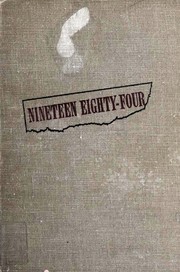
Nineteen Eighty-Four
Orwell's novel of a totalitarian state that watches its citizens and rewrites history; the source of 'Big Brother' and 'thoughtcrime'.
Why it was banned: Banned in the Soviet Union, where it circulated only in underground copies until it was published officially in 1988.
In printAffiliate link: Bookshop.org supports independent bookshops, and we earn a small commission at no extra cost to you.
What Nineteen Eighty-Four is about
Winston Smith works at the Ministry of Truth in London, the chief city of Airstrip One, a province of the superstate Oceania. His job is to rewrite old newspaper articles so that the record always agrees with whatever the ruling Party says today. Telescreens watch every room, the face of Big Brother looks down from every wall, and the Thought Police arrest people for crimes they have only imagined. Winston begins a forbidden diary and a forbidden affair with Julia, a young woman from the Fiction Department, and believes he has found an ally in O'Brien, a senior Party member. The last third of the novel follows what the Party does to him in the Ministry of Love and in Room 101.
The book gave English a vocabulary for surveillance and propaganda: Big Brother, thoughtcrime, doublethink, Newspeak, the memory hole, unpersons and the Two Minutes Hate. An appendix on "The Principles of Newspeak" explains the Party's plan to shrink the language until rebellious thoughts can no longer be expressed.
The ban, in full
Nineteen Eighty-Four was published in London by Secker & Warburg on 8 June 1949. In the Soviet Union it was banned outright: Soviet readers recognised Stalin's purges, show trials and rewritten history in Oceania, and so did the censors. Russian-language editions printed by émigré publishers abroad were smuggled in and passed from hand to hand, and possessing one could cost a reader their job or worse. The novel was only published officially in the USSR in 1988, during glasnost. It was likewise kept out of other Communist states for decades.
In the West the book has never been banned by a government, but it has repeatedly been challenged in schools. The American Library Association lists it among the classics most often challenged in the United States; objections over the years have called it pro-Communist, anti-Communist, depressing or sexually explicit.
About George Orwell
George Orwell was the pen name of Eric Arthur Blair (1903–1950), born in Motihari, India, and educated at Eton. He served in the Indian Imperial Police in Burma, lived among the poor in Paris and London for Down and Out in Paris and London, and was shot through the throat fighting for a left-wing militia in the Spanish Civil War, which he described in Homage to Catalonia. He wrote much of Nineteen Eighty-Four on the remote Scottish island of Jura while seriously ill with tuberculosis, and died in London in January 1950, seven months after it was published. His earlier satire Animal Farm was also banned in the Soviet bloc.
Which edition to read
The text is the same in all standard editions. In the US the most common paperback is the Signet Classic edition (the one our Bookshop link points to); in the UK it is the Penguin Modern Classics edition. Because Orwell died in 1950, the novel entered the public domain in the UK and EU on 1 January 2021, so many new editions have appeared there; in the United States it remains under copyright until 2044.
Reception and legacy
The novel was an immediate success and has never gone out of print. Sales jump whenever politics seems to echo it: in January 2017, after a US presidential adviser used the phrase "alternative facts", it reached the top of Amazon's bestseller list. It has been filmed twice (1956, and Michael Radford's 1984 version with John Hurt) and adapted many times for stage and radio. It is often read alongside Yevgeny Zamyatin's We, which Orwell reviewed in 1946, and Aldous Huxley's Brave New World. Huxley had briefly taught Orwell French at Eton.
Questions
Is Nineteen Eighty-Four still banned?
Not in Russia or the other former Soviet states, where it has been freely published since the late 1980s. It is restricted or unavailable in some authoritarian states today, and individual US schools still receive challenges to it.
Why was it banned in the Soviet Union?
Because its portrait of a one-party state built on surveillance, fear and falsified history was read as a portrait of Stalin's USSR. See more books banned in the Soviet Union and our list of banned dystopian novels.
At a glance
- Theme
- Classics, Fiction, Politics & power
- Shelf status
- In print
- Banned by
- A government
- Banned in
- Soviet Union
- Why it was banned
- Banned in the Soviet Union, where it circulated only in underground copies until it was published officially in 1988.
- Author
- George Orwell
- Topics
- Futurology, Censorship, Surveillance, Rebels, Sting operations, Historical negationism
- First published
- 1949
- Shelf note
- In print; ban history from the public record.
- Find a copy
- Bookshop.org ↗ (affiliate link)
Library record on Open Library
Banned Bookshelf lists books for reference. A listing is not an endorsement, and we host no copies.
Related
- Animal FarmClassics, Fiction, Politics & power
- Burger's DaughterClassics, Fiction, Politics & power
- Darkness at NoonClassics, Fiction, Politics & power
- Doctor ZhivagoClassics, Fiction, Politics & power
- WeClassics, Fiction, Politics & power
- All Quiet on the Western FrontClassics, Fiction
Cover image and topics: Open Library.