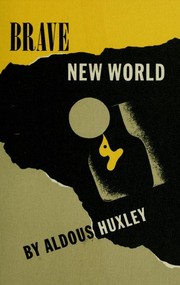
Brave New World
Huxley's novel of a future World State that keeps its people content through conditioning, consumerism and a drug called soma.
Why it was banned: Banned in Ireland in 1932 by the Censorship of Publications Board.
In printAffiliate link: Bookshop.org supports independent bookshops, and we earn a small commission at no extra cost to you.
What Brave New World is about
In the year 632 After Ford, the World State keeps everyone content. Children are grown in bottles and conditioned into five castes, from Alphas to Epsilons, each happy with its work. Sleep-teaching drills slogans into them; casual sex is encouraged and family, love and religion are treated as obscene relics. When anyone feels unhappy there is soma, a drug with "all the advantages of Christianity and alcohol; none of their defects".
Bernard Marx, an Alpha who feels out of place, visits a "savage reservation" in New Mexico with Lenina Crowne. There they meet John, the son of a woman from the World State who was left behind and gave birth naturally. John has grown up reading an old volume of Shakespeare, which gives the novel its title (from Miranda's line in The Tempest). Brought to London, he is first a celebrity and then a misfit. The novel ends with his long argument with Mustapha Mond, one of the World Controllers, over whether stability and comfort are worth the loss of art, truth, suffering and freedom.
The ban, in full
Brave New World was published in London by Chatto & Windus in 1932. The same year, Ireland's Censorship of Publications Board banned it, as it banned many modern novels, for its treatment of sex. In the United States it has never been banned by a government but has often been challenged in schools and libraries, for its sexual content and drug use and, sometimes, for its treatment of religion and of the reservation's Native American inhabitants. The American Library Association lists it among the most frequently challenged books.
About Aldous Huxley
Aldous Huxley (1894–1963) came from a famous English scientific family: his grandfather was the biologist T. H. Huxley and his brother Julian was a leading biologist. An eye disease in his teens left him nearly blind for a time and kept him out of medicine. Before Brave New World he was known for satirical novels such as Crome Yellow. In 1937 he moved to California, where he wrote screenplays, studied mysticism and, in The Doors of Perception (1954), described his experiments with mescaline. He died in Los Angeles on 22 November 1963, the same day as President Kennedy and C. S. Lewis.
Which edition to read
Most editions use the same text. Many include Huxley's 1946 foreword, in which he says he would now give John a third option between the World State and the reservation. Brave New World Revisited (1958), a non-fiction book of essays, looks at how close the real world had come to his predictions; some editions print the two together.
Reception and legacy
Reviews in 1932 were mixed, but the book sold steadily and became one of the most widely read dystopias. It is often compared with Nineteen Eighty-Four. In a 1949 letter to Orwell, his former pupil at Eton, Huxley predicted that future rulers would control people through pleasure and conditioning rather than through "clubs and prisons". It was adapted for television in 1980 and 1998 and as a series in 2020.
Questions
Why was Brave New World banned?
Ireland banned it in 1932 for its treatment of sex. Later challenges in schools have cited sex, drugs, religion and its language.
Is Brave New World still banned?
No government bans it today; Ireland's old bans have long lapsed. It still appears on lists of challenged books in US schools. See more books banned in Ireland and banned dystopian novels.
At a glance
- Shelf status
- In print
- Banned by
- A government
- Banned in
- Ireland
- Why it was banned
- Banned in Ireland in 1932 by the Censorship of Publications Board.
- Author
- Aldous Huxley
- Topics
- Utopias, Brainwashing, Moral and ethical aspects of Science, Science and state, Social problems, Passivity (Psychology)
- First published
- 1932
- Shelf note
- In print; ban history from the public record.
- Find a copy
- Bookshop.org ↗ (affiliate link)
Library record on Open Library
Banned Bookshelf lists books for reference. A listing is not an endorsement, and we host no copies.
Related
- The Children's StoryFiction, Media & propaganda
- All Quiet on the Western FrontClassics, Fiction
- Animal FarmClassics, Fiction, Politics & power
- Berlin AlexanderplatzClassics, Fiction
- Brainwashing and the CultsHypnosis & persuasion, Ritual abuse & cults
- Burger's DaughterClassics, Fiction, Politics & power
Cover image and topics: Open Library.