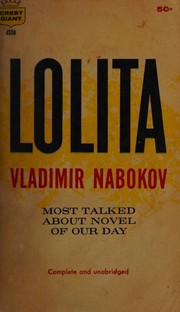
Lolita
Nabokov's novel narrated by Humbert Humbert, a man who abuses a twelve-year-old girl; first published in Paris by Olympia Press.
Why it was banned: Banned in France from 1956 to 1958, and copies were seized by UK Customs until its British publication in 1959.
In printAffiliate link: Bookshop.org supports independent bookshops, and we earn a small commission at no extra cost to you.
What Lolita is about
The novel is presented as the prison memoir of Humbert Humbert, a European-born literature scholar, written while he awaits trial for murder. He describes his obsession with young girls, his marriage to the widow Charlotte Haze in order to stay near her twelve-year-old daughter Dolores, and what follows Charlotte's sudden death: two years of driving Dolores across America from motel to motel, sexually abusing her, while she tries to escape him. A playwright, Clare Quilty, follows them and eventually takes Dolores away.
Humbert narrates in elaborate, witty prose and constantly asks for the reader's sympathy. Readers and critics have long read the book as a study of a self-justifying abuser, whose own words show the harm he does to a child he calls "Lolita" but who is, outside his story, an ordinary girl named Dolly.
The ban, in full
American publishers refused the manuscript, so Nabokov sent it to Olympia Press in Paris, run by Maurice Girodias, which published English-language erotica alongside serious literary work. It appeared in September 1955 in two green paperback volumes. At first it attracted little notice, until Graham Greene named it one of the best books of 1955 in the London Sunday Times and John Gordon of the Sunday Express attacked it as pornography.
In December 1956 the French Ministry of the Interior banned Lolita, along with two dozen other Olympia titles; the ban followed a request from British authorities. Girodias challenged it in court, and the ban was lifted in 1958. Meanwhile British customs seized imported copies. In the US, customs officials examined it and let it in, and G. P. Putnam's Sons published it in August 1958; it sold 100,000 copies in its first three weeks. In Britain, Weidenfeld & Nicolson published it in 1959 after the new Obscene Publications Act made a literary-merit defence possible, though the decision caused a political row. It was also banned for a time in other countries, including Argentina, New Zealand and South Africa.
About Vladimir Nabokov
Vladimir Nabokov (1899–1977) was born into an aristocratic family in St Petersburg and left Russia after the Revolution. He wrote nine novels in Russian in Berlin and Paris before moving to the United States in 1940 and switching to English. He taught literature at Wellesley and Cornell and was a serious lepidopterist who named several butterflies. The money from Lolita let him give up teaching and move to Montreux, Switzerland, where he died. He translated Lolita into Russian himself in 1967; it could not be published in the Soviet Union until 1989.
Which edition to read
The Annotated Lolita, edited by Alfred Appel Jr., explains the novel's many allusions and wordplay. Most editions include Nabokov's afterword "On a Book Entitled Lolita", in which he describes the book's difficult road to publication.
Reception and legacy
Lolita made Nabokov famous and is regularly listed among the great novels of the twentieth century. Stanley Kubrick filmed it in 1962 and Adrian Lyne in 1997; both films ran into trouble with censors or distributors of their own. Its title has entered the language in a sense very different from the book's portrait of Dolores Haze.
Questions
Why was Lolita banned?
For obscenity, because of its subject. The book contains no explicit sex scenes; it was the subject itself that censors objected to.
Is Lolita still banned?
It is freely sold in France, Britain and the US. More: books banned in France, books banned in the United Kingdom.
At a glance
- Shelf status
- In print
- Banned by
- A government, Customs
- Banned in
- France, United Kingdom
- Why it was banned
- Banned in France from 1956 to 1958, and copies were seized by UK Customs until its British publication in 1959.
- Author
- Vladimir Nabokov
- Topics
- Erotic fiction, Romance fiction, Love stories, Novela, Literary fiction, Classic fiction
- First published
- 1955
- Shelf note
- In print; ban history from the public record.
- Find a copy
- Bookshop.org ↗ (affiliate link)
Library record on Open Library
Banned Bookshelf lists books for reference. A listing is not an endorsement, and we host no copies.
Related
- Fahrenheit 451Classics, Fiction
- Madame BovaryClassics, Fiction
- The Satanic VersesClassics, Fiction, Religion & secret societies
- All Quiet on the Western FrontClassics, Fiction
- Animal FarmClassics, Fiction, Politics & power
- Berlin AlexanderplatzClassics, Fiction
Cover image and topics: Open Library.