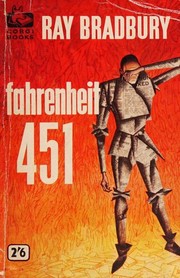
Fahrenheit 451
A novel about a fireman whose job is burning books, in a society that has outlawed them.
Why it was banned: From 1967 its own publisher sold an expurgated edition for schools that cut words and passages, without Bradbury's knowledge; when he found out years later, the full text was restored.
In printAffiliate link: Bookshop.org supports independent bookshops, and we earn a small commission at no extra cost to you.
What Fahrenheit 451 is about
Guy Montag is a fireman in a future America where houses are fireproof and firemen no longer put out fires: they start them, burning any books they find along with the houses that hide them. People spend their days in front of wall-sized television screens they call their "family", and drive too fast to notice the world. A conversation with his curious teenage neighbour, Clarisse McClellan, and a call-out to burn the library of a woman who chooses to die with her books, make Montag begin to doubt his work. He starts stealing books, seeks help from Faber, a retired English professor, and is hunted by his own fire chief, Captain Beatty, and the Mechanical Hound. He escapes the city to find a group of exiles who have each memorised a book, keeping literature alive until it can be printed again.
Bradbury said the title is the temperature at which book paper catches fire. He also said the novel is less about state censorship than about a public that stops reading on its own, with television and shortened, simplified culture doing the censors' work.
The ban, in full
The irony that made this book famous among censorship stories is that its main censor was its own publisher. From 1967 Ballantine Books sold a special edition for high schools in which about 75 passages were changed to remove swear words and references to drinking, nudity and sex. For years this was the only paperback edition in print, and Bradbury did not know about the changes. When students wrote to him about them, he had the full text restored; from 1979 Ballantine printed only the original, and Bradbury added a coda attacking anyone who cuts or rewrites books.
The novel has also been challenged in American schools for its language and its depiction of burning the Bible. In one widely reported case in 1992, a California middle school handed students copies with the "offensive" words blacked out, which led to complaints from parents and a reversal.
About Ray Bradbury
Ray Bradbury (1920–2012) grew up in Waukegan, Illinois, and Los Angeles, and never went to college; he said he educated himself in public libraries. He first told the story as a novella, "The Fireman", published in Galaxy magazine in 1951, typing the draft on coin-operated typewriters in the basement of UCLA's Powell Library at ten cents per half hour. He expanded it into the novel, published by Ballantine in October 1953 and serialised in the early issues of Playboy in 1954. His other books include The Martian Chronicles and Something Wicked This Way Comes.
Which edition to read
Make sure you have the unabridged text: any edition printed since 1979 is complete. Editions from the 1990s onward usually include Bradbury's coda and his afterword on how he wrote the book; the 60th-anniversary edition adds essays and early material.
Reception and legacy
Fahrenheit 451 became one of the most-read American novels of the century and a standard school text. François Truffaut filmed it in 1966, and HBO released a new film in 2018. Like Nineteen Eighty-Four and Brave New World, it is often taught as one of the great dystopias of the twentieth century.
Questions
Was Fahrenheit 451 actually banned?
It was censored rather than banned: its publisher sold a cut edition for years without the author's knowledge, and schools have challenged it. No government has banned it.
Is the version I have censored?
Only if it is a Ballantine "Bal-Hi" school edition printed between 1967 and 1979. More: books censored by their own publishers and banned dystopian novels.
At a glance
- Shelf status
- In print
- Banned by
- Its publisher
- Banned in
- United States
- Why it was banned
- From 1967 its own publisher sold an expurgated edition for schools that cut words and passages, without Bradbury's knowledge; when he found out years later, the full text was restored.
- Author
- Ray Bradbury
- Topics
- Mechanical Hound, Girl next door, Terrorismo estatal, Censura, Novela, Totalitarismo
- First published
- 1953
- Shelf note
- In print; ban history from the public record.
- Find a copy
- Bookshop.org ↗ (affiliate link)
Library record on Open Library
Banned Bookshelf lists books for reference. A listing is not an endorsement, and we host no copies.
Related
- LolitaClassics, Fiction
- All Quiet on the Western FrontClassics, Fiction
- Animal FarmClassics, Fiction, Politics & power
- Berlin AlexanderplatzClassics, Fiction
- Brave New WorldClassics, Fiction
- Burger's DaughterClassics, Fiction, Politics & power
Cover image and topics: Open Library.