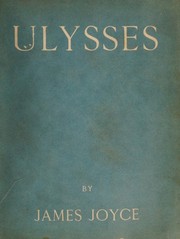
Ulysses
Joyce's modernist novel following Leopold Bloom through a single day in Dublin, 16 June 1904.
Why it was banned: Excerpts were prosecuted for obscenity in New York in 1921, and US Customs seized copies until a federal judge ruled in 1933 that the book was not obscene (United States v. One Book Called Ulysses).
In printAffiliate link: Bookshop.org supports independent bookshops, and we earn a small commission at no extra cost to you.
What Ulysses is about
Ulysses follows three Dubliners through a single day, Thursday 16 June 1904: Leopold Bloom, a Jewish advertising canvasser; his wife Molly, a singer who is having an affair; and Stephen Dedalus, a young teacher and would-be writer first seen in Joyce's A Portrait of the Artist as a Young Man. Bloom goes to a funeral, a newspaper office, a library, pubs, a beach and a maternity hospital, and late at night rescues a drunken Stephen in Dublin's red-light district. The novel's eighteen episodes loosely mirror Homer's Odyssey (Ulysses is the Latin name of Odysseus), with Bloom as the wandering hero, Stephen as his lost son and Molly as a far from faithful Penelope.
Each episode is written in a different style: stream of consciousness, newspaper headlines, a parody of romance fiction, a play script, a catechism of questions and answers, and finally Molly Bloom's unpunctuated monologue as she lies in bed. Fans celebrate 16 June every year as Bloomsday.
The ban, in full
Before it was a book, Ulysses was serialised from 1918 in the New York magazine The Little Review. The US Post Office seized and burned issues containing it, and in 1921, after the "Nausicaa" episode (in which Bloom watches a young woman on the beach), the New York Society for the Suppression of Vice brought a complaint. The editors, Margaret Anderson and Jane Heap, were convicted of publishing obscenity and fined, and the serialisation stopped.
No British or American publisher would touch the full book. Sylvia Beach, owner of the Paris bookshop Shakespeare and Company, published it on 2 February 1922, Joyce's fortieth birthday. Copies smuggled into the US and Britain were seized: US Customs and the Post Office burned hundreds, and British customs officers seized copies at the ports.
In 1932 Random House, wanting to publish it legally, arranged for a copy to be imported and seized so that the case could go to court. On 6 December 1933 Judge John M. Woolsey ruled in United States v. One Book Called Ulysses that the book was not obscene, because it had to be judged as a whole and by its effect on an ordinary reader, not by isolated passages. The Court of Appeals upheld him in 1934, and Random House published the first authorised American edition that year. The ruling became a landmark in American obscenity law. In Britain, the Bodley Head published it openly in 1936.
About James Joyce
James Joyce (1882–1941) was born in Dublin and left Ireland in 1904, living in Trieste, Zurich and Paris for the rest of his life, though he wrote only about Dublin. His short story collection Dubliners (1914) was delayed for years by publishers and printers worried about libel and obscenity. He wrote Ulysses over seven years while suffering from serious eye disease. His last novel, Finnegans Wake, appeared in 1939. He died in Zurich in 1941.
Which edition to read
The 1922 first edition was full of typesetting errors, and scholars still argue about which text is best. The 1961 Random House/Modern Library text and Hans Walter Gabler's 1984 "corrected text" are the two most common bases for modern editions. First-time readers often use an annotated edition or a companion guide; the Oxford World's Classics and Penguin Modern Classics editions include notes. Ulysses is in the public domain in the United States, the UK and the EU.
Reception and legacy
Even when banned, Ulysses was read and fought over by writers: T. S. Eliot praised it, Virginia Woolf disliked it, and it became the central book of literary modernism. It regularly tops lists of the greatest novels in English. Oddly, it was never formally banned in Ireland, though it was hard to find there for years.
Questions
Why was Ulysses banned?
For obscenity: its sexual frankness, especially in the "Nausicaa" episode and Molly Bloom's monologue, and its language.
When was the ban lifted?
In the US by Judge Woolsey's ruling of December 1933, upheld in 1934; in Britain with the 1936 Bodley Head edition. More: books banned in the United States, books seized by customs.
At a glance
- Shelf status
- In print
- Banned in
- United States
- Why it was banned
- Excerpts were prosecuted for obscenity in New York in 1921, and US Customs seized copies until a federal judge ruled in 1933 that the book was not obscene (United States v. One Book Called Ulysses).
- Author
- James Joyce
- Topics
- Married people, Male friendship, Historical Fiction, Psychological fiction, Alienation (Social psychology), Textual Criticism
- First published
- 1922
- Shelf note
- In print; ban history from the public record.
- Find a copy
- Bookshop.org ↗ (affiliate link)
Library record on Open Library
Banned Bookshelf lists books for reference. A listing is not an endorsement, and we host no copies.
Related
- All Quiet on the Western FrontClassics, Fiction
- Animal FarmClassics, Fiction, Politics & power
- Berlin AlexanderplatzClassics, Fiction
- Brave New WorldClassics, Fiction
- Burger's DaughterClassics, Fiction, Politics & power
- CandideClassics, Fiction
Cover image and topics: Open Library.