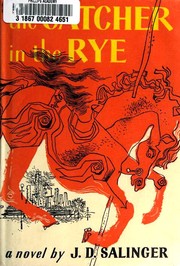
The Catcher in the Rye
Salinger's novel of Holden Caulfield's days in New York after being expelled from his school.
Why it was banned: Banned by Australian Customs from 1956 to 1957.
In printAffiliate link: Bookshop.org supports independent bookshops, and we earn a small commission at no extra cost to you.
What The Catcher in the Rye is about
Sixteen-year-old Holden Caulfield has just been expelled from Pencey Prep, his latest boarding school, a few days before Christmas break. Rather than go home and face his parents, he leaves early and spends two days drifting around New York City: a seedy hotel, nightclubs, a failed encounter with a prostitute and her pimp, an awkward date, a drunken night in Central Park, and a secret visit home to see his ten-year-old sister Phoebe, the person he loves most. Everywhere he goes he finds "phonies". Under his sarcasm, the novel slowly reveals his grief for his younger brother Allie, who died of leukaemia, and how close he is to breaking down.
The title comes from Holden's mishearing of a line from Robert Burns's song "Comin' Thro' the Rye". He tells Phoebe he imagines himself standing at the edge of a cliff by a field of rye, catching children before they fall: protecting their innocence, which is what he cannot do for himself.
The ban, in full
Little, Brown published the novel in July 1951. Australian Customs banned its import from 1956 to 1957, part of a long run of Australian bans on literary novels.
In the United States it has never been banned by a government, but for decades it was one of the books most often removed from or challenged in schools and libraries. Objections have cited its profanity, its sexual references, its teenage drinking and smoking, and Holden's rejection of adults' values. In 1960 a teacher in Tulsa, Oklahoma, lost his job after assigning it. The American Library Association lists it among the most challenged books of the twentieth century.
The book also gained a darker reputation: Mark David Chapman was carrying a copy when he shot John Lennon in New York in December 1980, and told police the book explained his actions.
About J. D. Salinger
Jerome David Salinger (1919–2010) grew up in Manhattan and served in the US Army in the Second World War, landing on Utah Beach on D-Day and fighting through the Hürtgen Forest; he carried early chapters of the novel with him. After Catcher made him famous, he published the stories in Nine Stories (1953) and Franny and Zooey (1961), then withdrew to Cornish, New Hampshire, and stopped publishing after 1965. He refused interviews, film rights and new editions of his uncollected work for the rest of his life.
Which edition to read
There is only one text. At Salinger's insistence, the Little, Brown paperback has a plain cover with no illustration, blurb or author photo.
Reception and legacy
Catcher became one of the best-selling novels of the century, sold steadily to each new generation of teenagers, and made Holden's voice a model for later coming-of-age fiction. Because Salinger refused all offers, it has never been filmed.
Questions
Why was The Catcher in the Rye banned?
For its swearing, sexual references and teenage rebellion. Australian Customs banned it from 1956 to 1957, and US schools have challenged it for the same reasons.
Is it still banned?
No government bans it today, but it still draws occasional school challenges. More: books banned in Australia, books seized by customs.
At a glance
- Shelf status
- In print
- Banned by
- Customs
- Banned in
- Australia
- Why it was banned
- Banned by Australian Customs from 1956 to 1957.
- Author
- J. D. Salinger
- Topics
- Fictional works, Runaway teenagers, Adolescence, Teenage boys, Runaway teenagers in literature, Brothers and sisters
- First published
- 1951
- Shelf note
- In print; ban history from the public record.
- Find a copy
- Bookshop.org ↗ (affiliate link)
Library record on Open Library
Banned Bookshelf lists books for reference. A listing is not an endorsement, and we host no copies.
Related
- All Quiet on the Western FrontClassics, Fiction
- Animal FarmClassics, Fiction, Politics & power
- Berlin AlexanderplatzClassics, Fiction
- Brave New WorldClassics, Fiction
- Burger's DaughterClassics, Fiction, Politics & power
- CandideClassics, Fiction
Cover image and topics: Open Library.